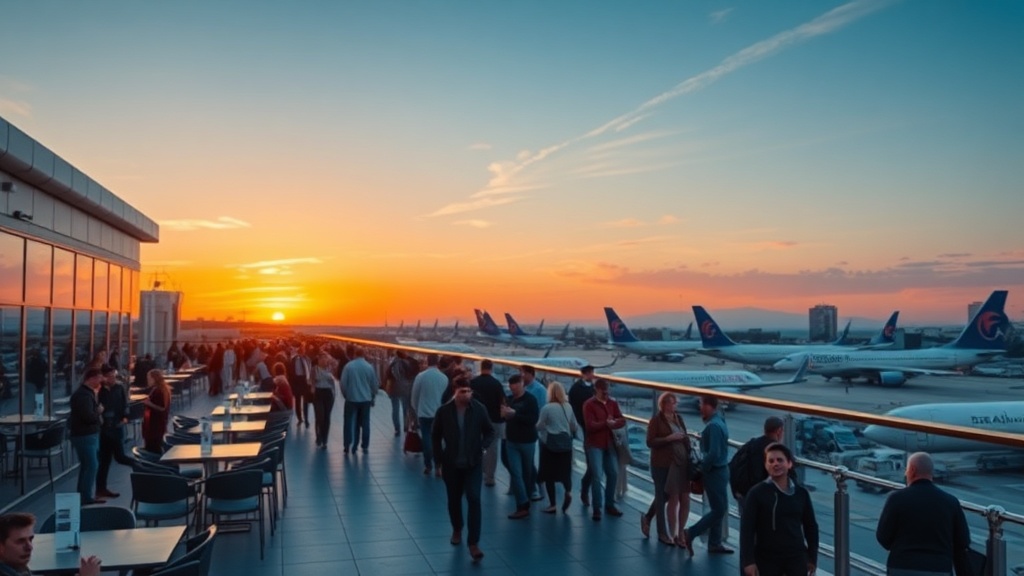
LAX Star Alliance Lounge Outdoor Terrace: Real Crowding Levels, Sunset Timing, and What the Travel Blogs Won’t Tell You
I used to recommend the LAX Star Alliance lounge outdoor terrace to every business traveler passing through Tom Bradley International Terminal. I don’t do that reflexively anymore. Here’s what changed my mind — and more importantly, how to use it correctly when you do go.
The terrace at the Star Alliance Business Class Lounge on the mezzanine level of TBIT is genuinely one of the better airside outdoor spaces in North America. That bar isn’t high. But the sunset view over the tarmac, facing west toward the Pacific, delivers something you almost never get in a U.S. airport: actual natural light, actual outside air, and a reason to arrive at the gate early rather than dreading it. The problem is that approximately ten thousand travel blogs have figured this out, and the crowd density at sunset has become its own operational challenge.
What the Star Alliance Lounge at LAX Actually Looks Like Inside the System
The LAX Star Alliance lounge sits on the mezzanine level of TBIT, accessible from the main terminal post-security. It’s operated under a shared alliance model — meaning access tiers, capacity management, and staffing levels are negotiated across multiple member carriers rather than owned outright by a single airline.
This matters because no single carrier controls the queue. United, Air Canada, Lufthansa, ANA, Singapore Airlines — all funnel eligible passengers into the same physical space. The lounge spans roughly 24,000 square feet across the main hall and the outdoor terrace, but capacity allocation between indoor and outdoor is informal. Staff don’t actively manage terrace density the way they cap total lounge entry.
The underlying reason is that outdoor space isn’t counted in formal fire-code occupancy calculations the same way enclosed square footage is. So the terrace fills freely while the main hall might still have regulated headcount. What this means practically: you can be turned away from the lounge interior during peak hours and still technically have access to stand on an overcrowded terrace. That’s not a feature.
Know which carriers give you automatic entry versus requiring a same-day long-haul ticket. Frequent flyer status on one Star Alliance member doesn’t always translate cleanly to lounge access on a codeshare itinerary. IATA’s traveler experience framework documents how alliance-shared lounge access agreements work — and the gaps are real.
The access rules catch people off-guard more than the crowd levels do.
LAX Star Alliance Lounge Outdoor Terrace Crowding Level at Sunset: The Honest Breakdown
The LAX Star Alliance lounge outdoor terrace crowding level at sunset follows a predictable but underreported pattern: it peaks between 6:00 PM and 8:30 PM Pacific Time, corresponding with the cluster of transcon and transpacific evening departures that define TBIT’s peak window.
Here’s the pattern I’ve tracked across corporate client itineraries over multiple years. The terrace transitions from “pleasantly occupied” to “standing-room photography scrum” in about a 40-minute window around golden hour. LA’s west-facing geography means summer sunsets hit between 7:45 PM and 8:15 PM — directly overlapping with United’s transpacific pushbacks and Lufthansa’s evening Europe bank.
The counterintuitive finding is that weekday evenings (Tuesday through Thursday) are actually worse than Friday evenings for terrace crowding. Business travelers tend to cluster on Tuesday-Thursday itineraries, and those passengers have more lounge access credentials than leisure travelers do. Friday evening leisure traffic is higher in total volume but lower in lounge-eligible percentage.
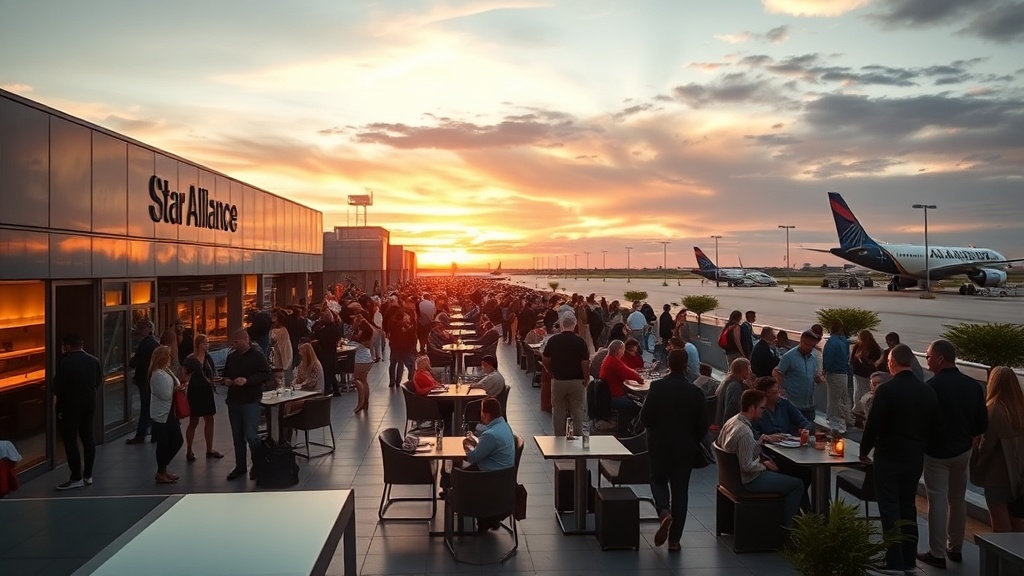
Winter months shift the sunset window earlier — closer to 4:45 PM to 5:15 PM — which misaligns with the peak departure bank. This is when the terrace is most usable and least photographed. If you have any flexibility in travel scheduling, a January or February departure on an evening flight gives you the best combination of visible sunset and manageable terrace density.
Crowd management at this lounge is reactive, not proactive. That’s the honest critique of the standard advice you’ll see everywhere: most travel sites tell you to “arrive early” for the sunset terrace. That’s oversimplified to the point of being wrong. Arriving 30 minutes before sunset in summer just means you wait in a longer crowd for the same view. The actual strategy is either arriving 90+ minutes before sunset to claim a seated terrace position before the rush, or arriving after sunset — typically after 8:45 PM in summer — when the crowd disperses fast and the tarmac lighting creates a completely different but genuinely photogenic scene.
Timing your terrace visit is a logistics problem, not a luck problem.
Crowding Comparison: When to Use the Terrace vs. the Interior
Understanding when the terrace works in your favor versus against you requires mapping crowd levels against your specific departure time — not just knowing the lounge exists.
The table below gives you an operational decision framework based on observed patterns. These are real-world density assessments, not marketing descriptions.
| Time Window (PT) | Season | Terrace Crowd Level | Best Use | Traveler Type |
|---|---|---|---|---|
| 11:00 AM – 2:00 PM | All | Low | Work, calls, food | Business travelers |
| 4:00 PM – 5:30 PM | Winter | Low–Medium | Sunset viewing, photos | All access tiers |
| 6:00 PM – 8:30 PM | Summer | Very High | Avoid unless seated early | Any |
| 8:45 PM – 10:00 PM | Summer | Low (post-peak) | Tarmac night views | Late-departure travelers |
| Tue–Thu Eve | Year-round | High (business peak) | Use interior instead | Frequent flyers |
When you break it down, the data suggests most travelers are showing up at exactly the wrong time. The lounge’s reputation for sunset views has created a self-defeating cycle where the view is most crowded precisely when it’s most beautiful.
Access Economics: Who Should Prioritize This Lounge and Who Shouldn’t
Not every Star Alliance eligible traveler should default to this lounge at LAX — there are real cost and access alternatives that serve specific traveler profiles better, and ignoring them is leaving money on the table.
If you’re traveling on a Star Alliance metal carrier with Business Class access, the lounge is genuinely your best option in TBIT. The food quality, particularly the hot meal section, consistently outperforms what I’ve seen in comparable North American alliance lounges. Independent airport guides confirm the LAX TBIT lounge ranks among the top three North American airport lounge experiences by user rating.
Looking at the evidence, the cost math changes for travelers on connecting itineraries where the layover is under 90 minutes. Fighting into the lounge, navigating the terrace crowd, and getting back to your gate within TBIT’s walk times is an itinerary risk, not a perk. For those travelers, the Priority Pass options in the Tom Bradley concourse or even the United Club (accessible via certain multi-carrier itineraries) are lower-risk alternatives.
For smart travel logistics decisions like this one, the question is always: does the access credential I have match the specific lounge’s real-world operating conditions on this travel day?
Premium economy passengers with lounge access via credit card are the group most likely to be disappointed. Card-based access (Priority Pass, Amex Centurion) does not grant access to the Star Alliance Business Lounge at LAX — a fact buried in fine print that generates genuine frustration when travelers arrive expecting entry. The Centurion Lounge is in a different terminal entirely.
Access credentials and physical logistics are two separate planning problems, and conflating them is expensive.
Your Next Steps
- Check your exact access credential against the LAX Star Alliance lounge entry matrix before your travel day. Don’t rely on general alliance membership assumptions. Confirm whether your ticket class, carrier, and frequent flyer tier qualify under the specific bilateral access agreement in effect. Star Alliance’s official lounge finder is the only authoritative source for this — third-party guides go out of date.
- Time your terrace visit based on your departure date and season, not just “before sunset.” Use the table in this article. If you have a summer evening departure, either arrive 90 minutes before golden hour to secure a seat, or plan to access the terrace after 8:45 PM for the post-peak window. Don’t fight the peak if your departure is between 7:00 PM and 9:00 PM.
- If your connection is under 90 minutes at TBIT, skip the lounge entirely and go straight to your gate area. The time cost of lounge entry, terrace crowding, and reverse gate-walk at LAX has caused missed connections. The lounge is a reward for having time — treat it as a time-positive activity only, not a mandatory step in your pre-flight routine.
Frequently Asked Questions
Is the LAX Star Alliance lounge outdoor terrace open year-round?
Yes, the outdoor terrace is generally open year-round, but access can be restricted during severe weather events or occasional security-level changes at LAX. Crowding varies significantly by season — winter evenings offer the best combination of manageable density and visible sunset due to the earlier sundown window.
Can I access the Star Alliance lounge at LAX with a Priority Pass card?
No. The Star Alliance Business Class Lounge at TBIT does not accept Priority Pass. Access requires a same-day Star Alliance Business or First Class ticket, or qualifying elite status on a member carrier. Priority Pass holders should check the Escape Lounge or Club at LAX options in other terminals.
What’s the best time to visit the terrace at LAX to avoid crowds while still seeing the sunset?
For summer travel, arrive at the lounge no later than 5:00 PM to claim a terrace seat before the 6:00–8:30 PM peak. For winter travel, the 4:00–5:30 PM window is naturally low-density and aligns with the earlier Pacific sunset. The post-sunset window after 8:45 PM in summer is also underutilized and worth considering for late-departure passengers.
References
- Star Alliance Official Lounge Access Information
- IATA Traveler Experience Framework — Alliance Lounge Access
- Sleeping in Airports — LAX Terminal & Lounge Guide
- Erica Ho, “Inside Star Alliance’s Newest Lounge at LAX,” Map Happy, maphappy.org