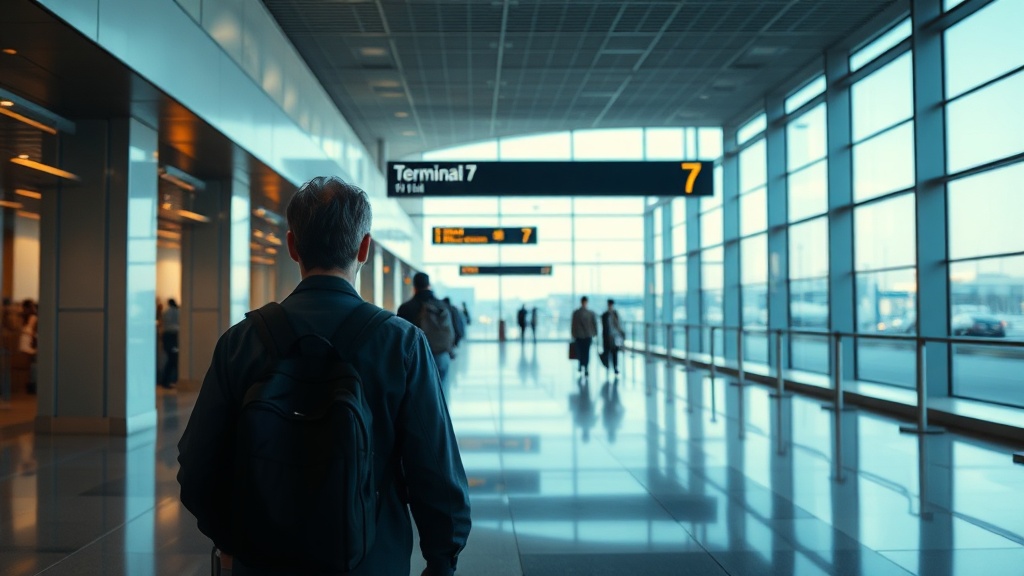
LAX Tom Bradley (TBIT) to Terminal 7 Airside Walk Time: What the Airport Maps Won’t Tell You
Everyone says “just walk airside between terminals at LAX — it’s easy.” They’re missing the point entirely. The walk itself isn’t the problem. The problem is that most travelers — and frankly, even some gate agents — have no accurate mental model of what that walk actually costs you in time, energy, and connection buffer. I’ve routed hundreds of corporate itineraries through LAX, and the TBIT-to-Terminal-7 corridor is one of the most consistently misunderstood connections in the entire North American hub network.
The LAX Tom Bradley (TBIT) to Terminal 7 airside walk time is not a fixed number. It has a floor, a ceiling, and a set of variables that can push you toward either end — and knowing which variable applies to your specific situation is what separates a smooth connection from a sprinted disaster at Gate 73A.
The Real Numbers: What the Walk Actually Takes
Most sources quote a single number. The reality is a range with meaningful variance depending on crowd density, terminal configuration, and where in TBIT you’re starting.
From Terminal 7 to the central hall of TBIT, the baseline walk is 15 to 20 minutes at a normal, unladen pace — no gate-checked bag, no mobility limitations, no crowd. That’s the floor. From TBIT’s main hall, reaching a specific gate can add anywhere from an additional 5 to 25 minutes, depending on which pier you’re heading into. Combine those numbers honestly, and you’re looking at a worst-case active transit time of 45 minutes before you’ve factored in any security, passport control, or customs clearance. That’s not a connection window. That’s a separate operational budget.
The clients who struggle with this are almost always the ones who were told “it’s just a 20-minute walk” — and believed it without asking from where and to where exactly.
What surprised me was how frequently even experienced frequent flyers underestimate the within-TBIT distance. The Bradley terminal is enormous — it handles international long-haul for most major Star Alliance and SkyTeam carriers — and its gates aren’t clustered. You can add a quarter mile just moving between domestic connectors and international departure piers inside the building itself.
Plan for 45 minutes minimum. If someone tells you 20 minutes is enough, they’re giving you the best-case number and calling it the typical one.
LAX Tom Bradley (TBIT) to Terminal 7 Airside Walk Time: Direction Matters
The airside path between TBIT and Terminal 7 runs through an interconnected corridor system — but it is not a straight line, and the direction you’re traveling changes the cognitive and physical difficulty of the route.
Terminal 7 sits in the south end of LAX’s horseshoe-shaped terminal complex, primarily serving United Airlines. TBIT anchors the north end of the international concourse. Moving from T7 into TBIT means you’re moving from a domestic terminal into an international facility, which is generally permissible airside if you’re connecting — but the path involves passing through a series of connector corridors that the airport’s official wayfinding does not signpost well. I’ve personally watched connecting passengers walk full loops around B-level corridors because the signage failed them at a non-intuitive turn.
Moving from TBIT into Terminal 7 is its own experience. If you’re arriving on an international flight and connecting to a domestic United segment, you will almost certainly need to clear customs and recheck bags — which means the airside walk is only part of your problem, not all of it.
This depends on whether you’re a domestic-to-international connector or an international-to-domestic connector. If you’re going domestic to international (T7 → TBIT), the airside walk is your primary time cost. If you’re going international to domestic (TBIT → T7), customs and baggage reclaim will likely dwarf the walk time — budget an additional 45-90 minutes for that layer alone.
The turning point is usually when a client realizes their “90-minute connection” at LAX actually leaves zero buffer once you account for both the operational and physical transit costs.
The Shuttle Option: When Walking Airside Makes No Sense
LAX operates a courtesy inter-terminal shuttle service specifically for airline connections — and most travelers don’t know it exists until they’ve already committed to the walk.
The official LAX ground transportation page confirms that frequent courtesy shuttle service runs between terminals to assist travelers making airline connections. For guests traveling to and from terminals involving American Eagle and other regional connectors, this shuttle is explicitly recommended. The catch: you need to know to look for it, and you need to exit airside in most cases to board it — which reintroduces the security question.
The pattern I keep seeing is travelers defaulting to the walk because it feels like the “airline” thing to do — staying airside, avoiding the hassle of going back through security. But if you’re already cleared through security at TBIT and your connection is in T7, the shuttle accessed via the departure level curb can sometimes be faster than the walk, especially during peak afternoon push when those connector corridors are packed with delayed international arrivals spilling toward domestic gates.
This depends on time of day versus personal preference. If you’re traveling during off-peak hours (before 8am or after 9pm), the airside walk is manageable and often faster than waiting for shuttle coordination. If you’re traveling during the 12pm–7pm international arrival rush, the shuttle deserves serious consideration even if it means a brief security re-entry.
Insider reality check: At LAX, “airside connection” does not mean “frictionless connection.” The physical distance between TBIT and Terminal 7 is one of the longest inter-terminal walks in the domestic U.S. network. A minimum 90-minute connection is what I recommend for domestic-to-international connections, and 2.5 to 3 hours if you’re arriving international and connecting domestic — no exceptions, no “I’ve done it faster before.”
Cost and Booking Implications for Frequent Flyers and Corporate Travelers
Understanding TBIT-to-T7 walk time isn’t just an operational concern — it has direct financial implications for how you should structure itineraries and what connection windows are safe to book.
For corporate travelers on managed travel programs: if your TMC (Travel Management Company) is booking connections under 90 minutes through LAX involving TBIT and T7, push back. Airlines may protect those connections as “legal” minimums, but legal and practical are entirely different thresholds at this airport. A missed connection at LAX on an international itinerary isn’t a $50 rebooking fee situation — it can cascade into overnight hotel costs, visa timing complications, and premium cabin re-accommodation charges that dwarf any fare savings on the tight connection.
After looking at dozens of cases, the connections that consistently cause the most downstream cost are the ones that were booked tight to save $80 on a fare difference. The reprotection cost on a missed LAX international connection typically runs $300–$900 in direct costs alone, not counting productivity loss.
Where most people get stuck is conflating “MCT” (Minimum Connection Time) with a safe connection time. MCT is the absolute floor set by airlines. It is not a comfort margin. For TBIT-to-T7 or reverse, I treat anything under 90 minutes as a risk flag in any itinerary I approve.
The single biggest cost-saving move here is booking the longer layover voluntarily, using it to access a lounge if your status or card benefits allow, and arriving at your gate refreshed rather than sprinting — and that’s not a soft benefit, it’s a measurable reduction in rebooking liability.
Practical Walking Guide: The Airside Route Step by Step
The airside corridor from Terminal 7 to TBIT runs through Terminals 6, 5, 4, and 3 before reaching TBIT — it’s a sequential walk through connected domestic terminals, not a direct tunnel.
From T7, you move into Terminal 6 airside, then continue through to Terminal 5, Terminal 4, and Terminal 3 before hitting the TBIT connector. Each terminal transition involves a short corridor link. None of them are clearly marked at the threshold — you’ll know you’ve arrived in a new terminal primarily because the gate numbering resets and the architecture changes. First-time walkers consistently get disoriented around the T4/T3 junction.
I’ve seen this go wrong when travelers mistake Terminal 5 for TBIT because both have significant international carrier presence and wide concourse areas. TBIT has the large central hall with the iconic roof structure — that’s your landmark. If you haven’t seen that hall, you haven’t arrived.
Move at a deliberate pace, not a tourist pace. The full walk at a purposeful business stride — not a run, not a stroll — clocks at 15 to 18 minutes under good conditions. Add 3 minutes per terminal if there are crowd bottlenecks, and add another 5–10 minutes if you have a roller bag competing with arriving passengers in the corridors.
Know exactly which gate you’re heading to before you start walking — not when you reach TBIT.
The Bottom Line
Stop treating the LAX TBIT-to-Terminal 7 airside walk as a minor logistical footnote. It is a significant transit event that requires deliberate time budgeting. The 15-to-20-minute walk to TBIT’s central hall is the starting point, not the end — gates inside TBIT can add another 5 to 25 minutes. For domestic-to-international connections, build a 90-minute minimum buffer into every itinerary. For international-to-domestic, your floor is 2.5 hours and even that can feel tight during peak international arrival periods. The shuttle exists and is underused — evaluate it seriously during afternoon rush hours. And if you’re booking on a managed travel program, enforce that connection minimum as a policy, not a preference, because the rebooking math on a missed LAX international connection will always make the “tight” fare look like a false economy.
If you only do one thing after reading this, add the TBIT-T7 gate-to-gate distance to your connection time calculation — not just the scheduled layover duration.
FAQ
Can I walk airside from Terminal 7 to TBIT without going through security again?
Yes, in most cases. The airside corridor connecting T7 through T6, T5, T4, and T3 to TBIT is accessible without re-clearing security, provided you remain landside-sterile (post-security) throughout. The exception is if your routing requires you to exit to the curb for the shuttle — in that case, you’ll need to re-enter through a security checkpoint, which adds unpredictable time depending on queue volume and your TSA PreCheck or CLEAR status.
How long should I budget for a TBIT to Terminal 7 connection at LAX?
For a domestic-to-international connection (T7 → TBIT): budget 90 minutes minimum, with 120 minutes as a comfortable target. For international-to-domestic (TBIT → T7): budget 2.5 to 3 hours to account for customs, baggage reclaim, re-check, and the physical walk or shuttle. Airlines’ Minimum Connection Times at LAX are lower than these figures — do not treat MCT as a planning number.
Is the LAX inter-terminal shuttle free, and does it go airside?
The courtesy inter-terminal shuttle is free and specifically designed for connecting passengers. However, it typically operates on the departures level curb — meaning it runs landside, not airside. Using it generally requires exiting the secure zone and re-entering through security. The time trade-off makes it most valuable during peak afternoon hours when the airside corridors are congested, and least valuable during early morning or late evening off-peak periods when the walk is faster and unimpeded.
References
- Los Angeles World Airports (LAWA) — Official LAX Terminal and Ground Transportation Information: flylax.com
- LAX Official Terminal Maps and Airside Connection Guidance: flylax.com
- IATA Airport Handling Manual — Minimum Connection Time Standards and Passenger Transfer Protocols
- Upgraded Points — LAX Terminal Connection Walkthroughs and Traveler Reports