
IST Istanbul New Airport Walking Distance Gate A to F: What Every Frequent Flyer Gets Wrong
Everyone says “arrive two hours early at IST and you’ll be fine.” They’re missing the point entirely. The real variable isn’t check-in time — it’s where your gate is.
IST Istanbul New Airport is the fourth largest airport in the world by terminal floor area. That’s not a badge of honor for the traveler with a 55-minute connection. That’s a logistical hazard. And the walking distance between Gate A and Gate F at IST is one of the most underestimated challenges in international transit routing — one I’ve seen derail otherwise perfectly constructed itineraries for corporate clients flying through Istanbul on Turkish Airlines hubs.
Let me break this down from the inside.
Why IST’s Gate Layout Breaks Standard Connection Logic
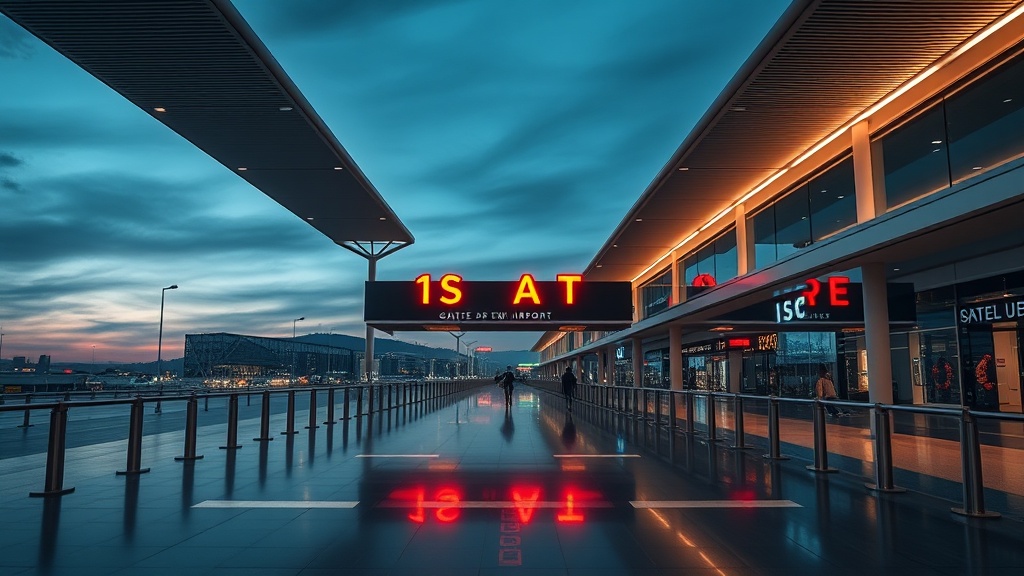
IST operates on a single mega-terminal design spanning six concourses — A through F — with an internal walking span that can exceed 1.8 kilometers from the farthest domestic pier to the international satellite gates.
Most hub airports — Frankfurt, Amsterdam, Dubai — use satellite terminals with automated people movers to solve the distance problem. IST chose a different architecture. The terminal is continuous, which sounds elegant on paper. Under the hood, it means passengers walk. A lot.
The concourses at IST are laid out linearly and in branching piers off the central spine. Gate A concourse handles primarily domestic Turkish Airlines operations and select short-haul international routes. Moving through B and C gets you into medium-haul international territory. By the time you reach Gates E and F — which handle long-haul widebody departures and the busiest international rotations — you’re looking at a significant hike from the check-in hall or from an A-gate arrival.
The failure mode here is assuming that because you cleared passport control, you’re close to your gate. You’re not. Passport control at IST sits centrally in the terminal, which creates a false sense of arrival. Your gate could still be 15-20 minutes of brisk walking away.
IST Istanbul New Airport Walking Distance Gate A to F: The Real Numbers
Gate A to Gate F at IST covers approximately 1.5 to 2 kilometers of terminal walking depending on your specific gate assignment, with no automated transit connection between all six concourses.
Here’s what the airline apps don’t show you: gate numbers within each concourse vary dramatically in actual distance. Gate A1 to A15 can itself span several hundred meters. When you’re routing from, say, a domestic arrival at A-pier to a departing widebody at F-pier, you’re not talking about a casual stroll — you’re talking about 20 to 30 minutes at normal walking pace, factoring in the terminal’s signature crowds during peak Turkish Airlines banks (typically 06:00–09:00 and 14:00–18:00 local time).
The tradeoff is speed versus comfort. IST does have moving walkways on segments of the main spine, but they’re not continuous. Gaps exist, particularly around the retail concession zones where airport operators deliberately slow pedestrian flow.
Key Insight from the Field: “For connection times under 75 minutes at IST with a Gate A arrival and Gate E/F departure, I flag the itinerary as high-risk regardless of the published minimum connection time. IST’s MCT (Minimum Connection Time) of 60 minutes for international-to-international is technically correct — operationally, it assumes ideal conditions that rarely exist during Turkish Airlines’ peak banks.”
Which Traveler Types Feel the Distance Most
Not all passengers experience IST’s gate distances equally — your risk profile depends entirely on your connection window, physical mobility, and whether you have lounge access that’s strategically positioned.
For business travelers with elite status, the Turkish Airlines CIP lounge system partially mitigates this. The main CIP lounge sits in the international zone near the central spine, which is closer to mid-terminal concourses. If you’re connecting from a C or D gate arrival, the lounge is a reasonable pitstop. If you’re connecting from Gate A domestic to Gate F international, stopping at the lounge is a time trap — I’ve watched senior executives miss connections because they assumed the lounge was near their departure gate.
Leisure travelers and families face the hardest version of this problem. Slower walking pace, stroller logistics, kids who want to stop at every duty-free display — IST’s design is unforgiving. Budget 40 minutes minimum for any Gate A to Gate F crossing with children.
Premium economy and business class passengers on Turkish Airlines have one under-utilized option: request a gate buggy at arrival. IST has a fleet of electric mobility carts. Most passengers don’t know to ask. This is a legitimate service, not just for passengers with mobility limitations. Ask at the gate podium upon arrival or at any ground crew station. This matters because it can cut a 25-minute walk to under 10 minutes.
Cost Implications: When the Wrong Connection Costs Real Money
A missed connection at IST due to gate distance miscalculation can trigger rebooking fees, hotel costs, and lost business productivity that far exceed the savings of booking a tight layover fare.
I’ve audited travel programs where a corporate traveler saved €80 on a ticket by booking a 65-minute connection at IST — then spent €340 on a last-minute hotel and rebooking surcharge after missing the onward flight. The math is simple. The temptation to book the cheaper tight connection is strong, especially when booking tools don’t flag IST’s terminal complexity.
According to IATA’s Minimum Connection Time database, IST’s published MCTs are 60 minutes for international-to-international connections. What that database cannot quantify is the spatial reality of a Gate A15 to Gate F8 crossing during a peak Turkish Airlines bank. The published number is a floor, not a comfortable target.
Most guides won’t tell you this, but: booking a 90-minute connection at IST is almost always cheaper in total cost of travel than a 60-minute connection when you factor in the real-world missed connection rate on tight IST transits. The airline rarely compensates you for a missed connection caused by “insufficient connection time” — because they’ll argue the time was technically sufficient.
Practical Strategies for Managing Gate A to F Distance at IST
Knowing the distances is only half the equation — the other half is building your transit plan around IST’s specific operational rhythms and physical layout before you land.
First, check your inbound gate assignment as early as possible using the Turkish Airlines app or FlightRadar24. Gates at IST are generally assigned 24-36 hours out. If you’re arriving at Gate A and departing from Gate F, you have time to mentally plan your route — and decide whether to skip the lounge, skip duty-free, and go straight to the gate.
Second, use the IST airport map available on the official Istanbul Airport website. The map is more detailed than what Google Maps shows. Print it or screenshot it — terminal WiFi at IST is reliable but can be congested during peak times.
Third, if you’re a corporate traveler managing a team’s itineraries through Istanbul, flag any IST connection under 90 minutes as requiring manual review. Build a standard operating procedure around it. From a systems perspective, one missed connection in a group of six travelers can cascade into a full day of rebooking across multiple carriers.
Unpopular opinion: IST’s single-terminal mega-design is actually better for premium long-haul travelers than a satellite model — but only if your connections stay within the D-through-F concourse zone. The problem is almost entirely concentrated in A-and-B-to-E-and-F crossings. If you can influence your routing to minimize that specific crossing, the airport’s integrated retail and lounge experience is genuinely superior to Frankfurt or Heathrow’s fragmented satellites.
FAQ: IST Istanbul New Airport Gate Distances
How long does it actually take to walk from Gate A to Gate F at IST Istanbul New Airport?
Under normal conditions, at a brisk walking pace without stops, expect 20 to 30 minutes. During peak hours — particularly the morning and afternoon Turkish Airlines departure banks — add 10 to 15 minutes for crowd congestion in the central terminal spine. If you’re stopping at security re-screening points between domestic and international zones, add another 10 minutes minimum.
Does IST have people movers or shuttle buses between concourses?
IST does not have an automated people mover connecting all concourses. Moving walkways exist on portions of the main terminal spine but are not continuous. Electric buggy assistance is available upon request from ground staff, which is the fastest option for passengers with tight connections or reduced mobility. There are no inter-terminal shuttle buses because IST operates as a single connected terminal — the entire airport is under one roof.
What is the minimum safe connection time at IST for international-to-international flights?
IATA’s published MCT for IST international-to-international is 60 minutes. In practice, for connections involving Gate A arrivals and Gate E or F departures, 90 minutes is the operational safe minimum. For connections that remain within the same concourse cluster (C to D, or E to F), 60 to 75 minutes is workable for unencumbered travelers. For families, business travelers with checked luggage concerns, or any traveler unfamiliar with the terminal layout, 90 to 105 minutes is the professionally recommended buffer.
References
- IATA Minimum Connection Time Database — https://www.iata.org/en/services/statistics/intelligence/mct/
- Istanbul Airport Official Terminal Map — https://www.istairport.com
- Cestee Airport Guide — Istanbul IST — https://www.cestee.com/airport/istanbul-ist
- Turkish Airlines Ground Services — Connection Assistance Procedures (IATA ITP Training Materials, 2024)
If IST continues expanding its concourse capacity toward a projected Gate G designation in the coming years, will airports that prioritize architectural grandeur over passenger transit efficiency eventually push travelers toward routing alternatives — and what does that mean for Istanbul’s ambition to become the world’s top connecting hub?